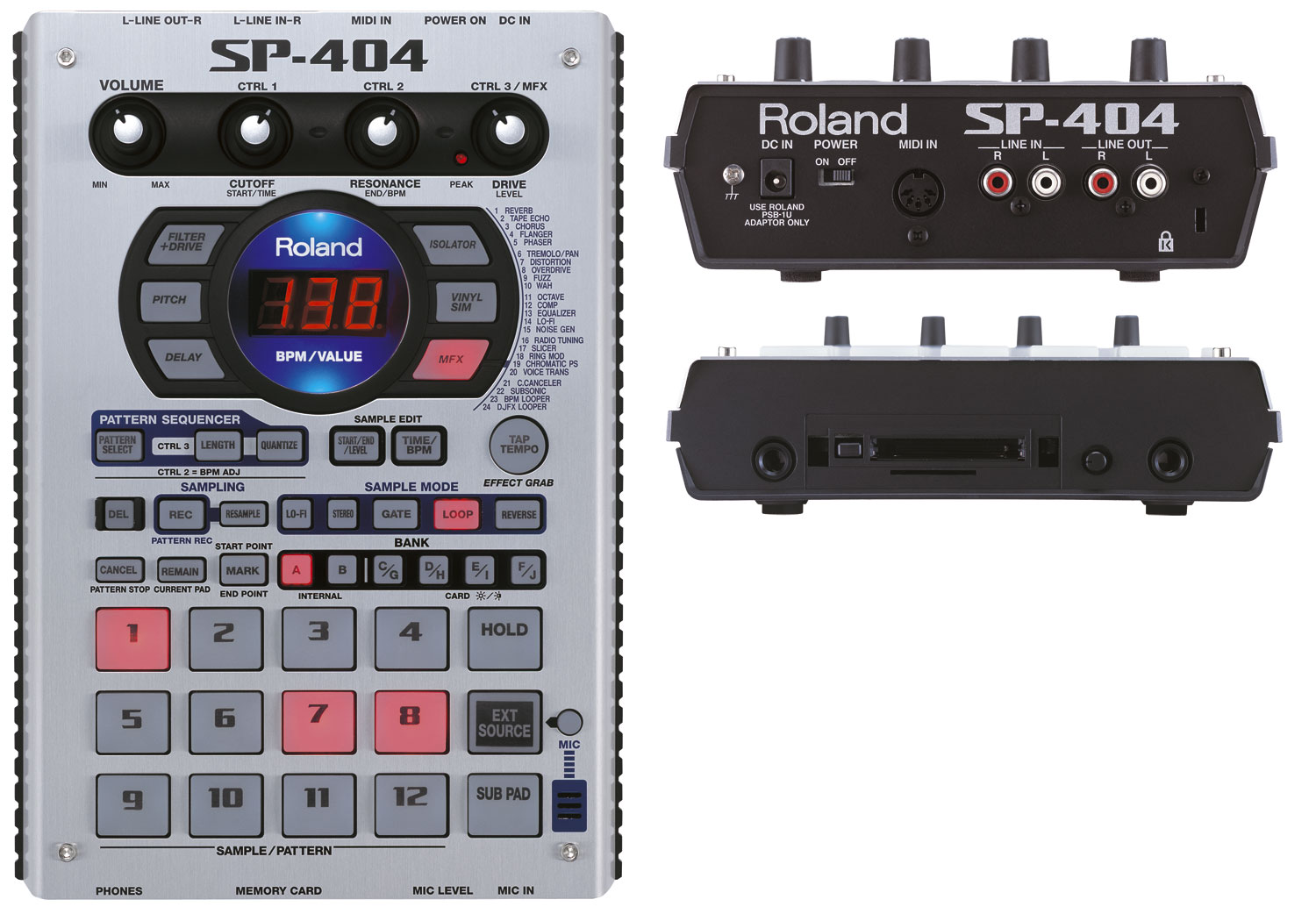
The Roland SP-404 MK2 is one of the most popular boxes in beat-making, and for good reason. It is a sampler, a performance instrument and an effects unit in one portable package. This guide is about workflow: how to actually build and finish a track on it, rather than a list of features.
If you want the wider context of where a sampler sits in a hardware rig, start with our guide to building a dawless setup. For the creative side of pushing the SP-404 past straight sampling, our earlier piece on taking the SP-404 beyond sampling is a good companion.
What you are working with
According to Roland, the SP-404 MK2 has 17 velocity-sensitive pads and holds up to 160 samples per project. It offers a maximum sampling time of about 16 minutes, 16 GB of internal storage, and a card slot for backup and transfer. It runs from an AC adapter, a USB battery pack or six AA batteries, so it works anywhere. For effects it carries 41 types of multi-effects plus 17 input effects, which is the part that gives SP-404 tracks their recognisable character.
The most important idea is that a pad can hold anything: a drum hit, a chopped vocal, a bassline, a whole loop. You build a beat by playing pads and letting the pattern sequencer capture it.
Step one: get sound in
Sampling is the heart of the machine. You can sample from the line inputs, resample the SP-404’s own output, or import audio from the card. Set your input level so the loudest part sits just below clipping, then record. Keep samples slightly longer than you think you need, because you can always trim afterwards in the sample editor.
A quick habit that pays off: name your projects and back them up to the card often. Losing an hour of chopped samples to a flat battery is a rite of passage nobody enjoys twice.
Step two: chop and assign
Once a sample is in, use the editing tools to set start and end points and to chop a long phrase into individual hits spread across pads. This is how a two-bar soul loop becomes a fresh drum kit or a melodic phrase you can replay in any order. Assign related sounds to nearby pads so your fingers learn the layout.
Step three: sequence the pattern
The pattern sequencer records what you play on the pads. Set a tempo, start the sequencer and play your part in real time, or step through it more slowly and build it up. Roland lists a variable pattern length of 1 to 64 bars, so you are not locked into short loops. Layer drums first, then bass, then melody, checking that each new part still leaves room for the others.
Step four: effects and movement
Effects are where the SP-404 stops sounding like a plain sampler. The classic moves are the resonant filter, the vinyl simulation, the cassette and lo-fi effects, and the delays. Assign an effect to the effect control and perform it live, sweeping a filter across a breakdown or dropping a delay throw at the end of a phrase. Because these gestures are part of the performance, they make a loop feel like a song.
When you have a version you like, resample the whole thing back into a single pad. Now you can add another layer of effects on top, or drop that finished loop into an arrangement.
Step five: finish it
Finishing is where dawless boxes shine, because there is no infinite undo tempting you to keep fiddling. Arrange your patterns into a rough structure, perform your effect moves, and record the output. You can resample inside the SP-404, or send the output to a recorder or into a DAW. If you take the DAW route, our guide to integrating hardware with Ableton Live covers how to capture and line up the audio.
A workflow that keeps you moving
The SP-404 rewards commitment. Sample something, chop it, sequence a pattern, perform the effects, resample, repeat. Each pass bakes in a decision and moves the track forward. That loop is the whole reason producers reach for hardware in the first place, and the SP-404 MK2 is one of the friendliest places to learn it.
Last fact-checked: 14 October 2026