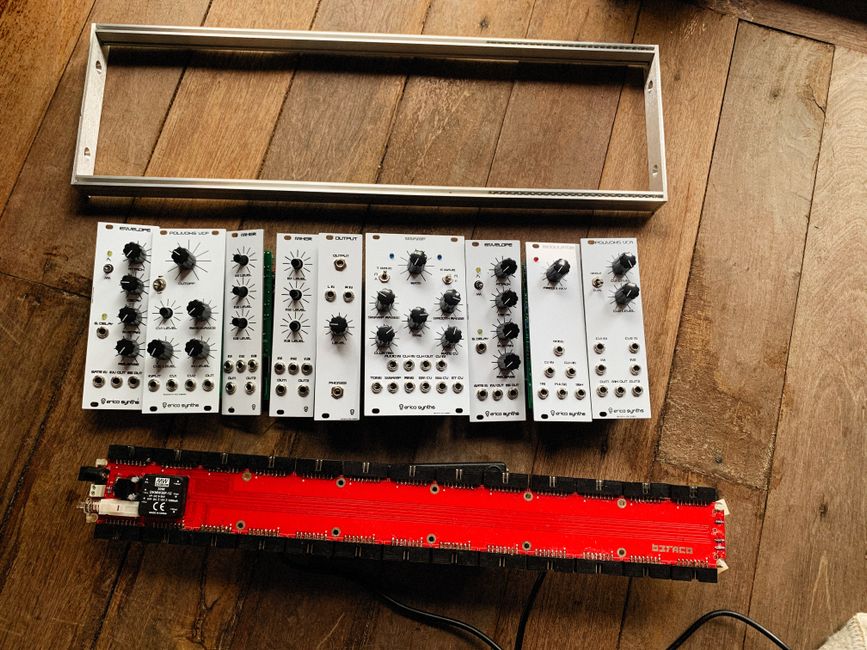
Eurorack is modular synthesis, where instead of buying a finished synth you build one from individual modules and patch them together with cables. It is endlessly flexible and genuinely fun, and it is also the easiest way in music hardware to spend a lot of money by accident. This guide explains how the format works and how to start small.
Modular is usually a later step in a dawless setup, not a first purchase. If you are still choosing your core instrument, an all-in-one groovebox is a better place to begin.
What Eurorack actually is
Eurorack is a physical and electrical standard, originally defined by the German company Doepfer for its A-100 system. Modules are 3U tall and their width is measured in HP, roughly 5 mm per unit. They sit in a case and draw power from a shared bus board, which supplies plus and minus 12 volts. Because the standard is open, thousands of modules from hundreds of makers all fit the same case. That interoperability is the whole appeal.
Modules talk to each other with voltage. Two signal types matter most. Control voltage, or CV, sets things like pitch, using the widely adopted standard of one volt per octave. Gate signals are simple on-and-off pulses that tell a sound to start or stop. You can read more format detail on the Eurorack overview.
The parts of a basic voice
To make a single playable sound, a classic subtractive setup needs a handful of module types working together.
- An oscillator (VCO) generates the raw tone. Its pitch is set by a CV input.
- A filter (VCF) shapes the tone by removing frequencies, which is where a lot of the character comes from.
- An amplifier (VCA) controls the volume over time so notes fade in and out instead of playing constantly.
- An envelope generator creates the shape that drives the amplifier and often the filter.
- Something to play it, such as a sequencer or a keyboard that sends pitch CV and gates.
Patch the oscillator into the filter, the filter into the amplifier, an envelope into the amplifier, and a sequencer into the oscillator’s pitch input, and you have a synth voice you built yourself.
Start with a case and a plan
The two things beginners underestimate are the case and the power. Every module needs space in the case, measured in HP, and every module draws current from the power supply. Add up both before you buy, because running out of space or power halfway through a build is a common and annoying mistake. A powered case or a self-contained starter case removes the guesswork.
A sensible first system is a single complete voice plus a way to sequence it, all in one small case. Resist the urge to buy ten interesting modules at once. Learn to patch the basics first, then add modules that solve a specific problem you have actually run into.
Semi-modular as a stepping stone
If full Eurorack feels like too much, a semi-modular synth is an excellent bridge. Instruments in this class are already wired to make sound on their own, so you get music immediately, but they also have a patch bay so you can start experimenting with cables. Many of them use the same CV and gate standards as Eurorack, so the skills transfer directly.
Connecting modular to the rest of your gear
Modular does not have to be an island. You can sync it to a sequencer or a DAW so it plays in time with your other hardware. Ableton’s CV Tools pack, for example, sends control voltage from the software to a modular system through a DC-coupled audio interface. Our guide to integrating hardware with Ableton Live covers that bridge, and syncing a dawless jam explains how to keep clock steady across everything.
Go slow and enjoy it
Eurorack is a hobby as much as an instrument. The trick is to treat every module as something you will actually patch, not something to collect. Build one voice, learn it deeply, and let your system grow around the music you make rather than the modules that look exciting online.
Last fact-checked: 14 October 2026