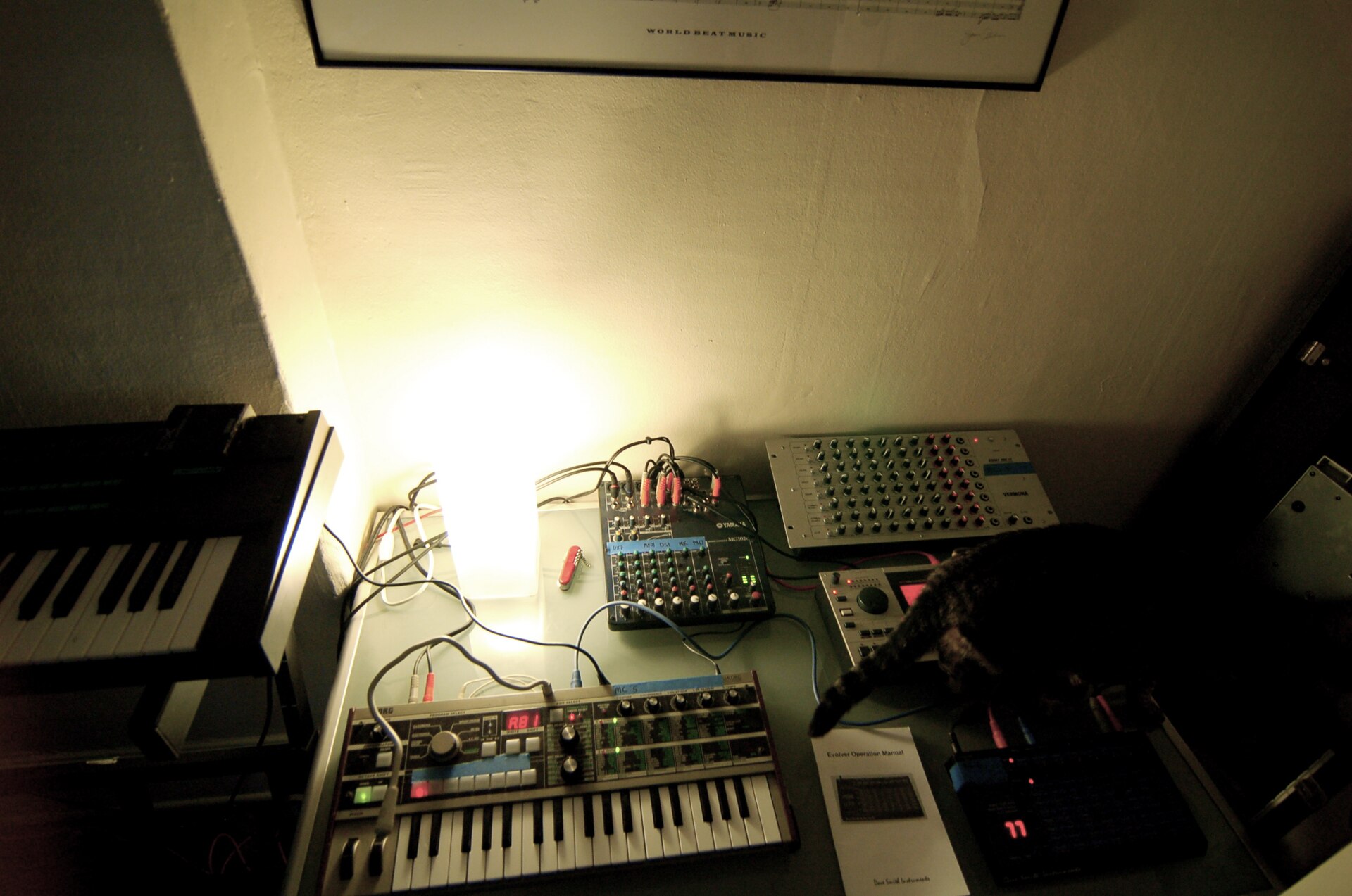
With two boxes you may not need a mixer at all, because the groovebox in the middle of the rig often has a stereo line input of its own. With three boxes on their own channels, a mixer for synths needs two stereo channels and one mono channel for a synth with a single output. A spare stereo channel brings the count to four. Count stereo pairs rather than channels before you buy, and decide whether you want to record the finished mix or every box on its own track.
A mixer’s channel count is not the number of boxes it takes
The number on the box counts mono and stereo channels together. The Yamaha MG10XU is sold as a 10-channel mixer, and those 10 channels are four mono mic/line channels plus three stereo line channels. The Zoom LiveTrak L-8 has eight channels, and six of them are mono mic/line channels.
A groovebox or drum machine with left and right outputs needs one stereo channel or two mono channels panned hard left and right. A synth with a single output needs one mono channel. Read the rear panel of every box you own before you read the mixer’s spec sheet.
How many mixer channels one, two and three boxes need
The three rigs follow the steps in building a dawless music setup: one box to start, a second sound source later, and eventually a third. The center box is a Roland SP-404 MK2 or an Elektron Digitakt II. The Arturia MicroFreak stands in for the synth because it has a single line output.
| Rig | Boxes and their audio outputs | Mixer channels needed |
|---|---|---|
| First setup | SP-404 MK2 or Digitakt II: one stereo pair (left and right) | None. Headphones or a recorder go straight into the box. |
| Second sound source | Center box: one stereo pair. MicroFreak: one balanced line output. | None. The synth goes into the center box’s line input. |
| Third box | Center box: one stereo pair. MicroFreak: one output. A stereo drum machine: one stereo pair. | Three: two stereo channels and one mono channel, or five mono channels. That count gives every box its own channel. With the synth kept on the center box’s line input, as in the row above, two stereo channels are enough. |
The SP-404 MK2 has LINE OUT jacks on 1/4-inch TRS and LINE IN jacks, both labeled L/MONO and R, plus a separate mic/guitar input. The Digitakt II has OUT L/R and IN L/R on 1/4-inch jacks and a headphone output. Arturia lists one 1/4-inch balanced line-level output on the MicroFreak, next to a 3.5 mm headphone jack.
With every box on its own channel plus one spare stereo channel, the third rig needs four channels. That spare is the slot for a fourth box, a phone playing a reference track, or the return from a computer.
Your groovebox can be the mixer for the second box
Both center boxes mix their line input into their own output. On the SP-404 MK2, the external inputs are routed to BUS 1, BUS 2 or the DRY bus, so the synth can go through the same effects as your samples. The SP-404 MK2 also has 17 input effects of its own for the external inputs.
The Digitakt II has a dedicated External Mixer page for IN L/R with a level control and separate sends to the chorus, delay and reverb. With Dual Mono switched on, the left and right inputs become two mono inputs with their own pan. Two mono synths can then share the one stereo input.
The limit is one stereo pair. When the third box arrives, that pair is taken, and you either chain boxes through each other’s inputs or buy a mixer.
Stereo-USB mixers record the mix, multitrack mixers each box
| Yamaha MG10XU | Zoom LiveTrak L-8 | 1010music Bluebox | |
|---|---|---|---|
| Inputs | 4 mono mic/line, 3 stereo line | 6 mono mic/line, 2 line jacks on channels 7 and 8 | 6 stereo 3.5 mm TRS, mapped as up to 12 mono or 6 stereo tracks |
| Third rig fits? | Yes: two stereo channels and one mono channel, with one stereo channel spare | Yes: the two stereo boxes on four of channels 3 to 6, the mono synth on the LINE jack of channel 7 or 8 | Yes: three of the six stereo inputs |
| Effects | Internal SPX effect with 24 programs and one FX send | One send effect bus with 8 effect types | Delay and reverb sends, compressor on the main output |
| What it records | The stereo mix only, over USB | Up to 12 tracks to SD card, or 12 channels over USB | One WAV file per armed track plus the main mix, to microSD |
On the MG10XU, the stereo bus is what goes to the computer over USB, and the specifications give the USB audio as 2 in and 2 out. You get one stereo file of the whole jam. If the drum machine was too loud, it stays too loud. Sound from the computer comes back on channels 9/10 when that channel’s switch is set to USB, and then those two jacks are out of use.
The L-8 records up to 12 tracks at once to an SD card and works as a 12-in/4-out USB audio interface, where each input and the master output reach the computer separately. Every box lands on its own track, so the balance can be fixed afterwards. Channels 3 to 6 have a 26 dB pad for line-level sources, so the two stereo boxes of the third rig belong there. Channels 1 and 2 have no pad and reach full scale at -2 dBu, so the mono synth goes on the LINE jack of channel 7 or 8, which takes up to +3 dBu.
The Bluebox writes one WAV file for each armed track and one for the main mix as 24-bit, 48 kHz files on the microSD card. The card then goes to the computer. The Bluebox inputs are 3.5 mm, so boxes with 1/4-inch outputs need adapter cables. 1010music lists the Bluebox at USD 599 in its own web shop (October 2026).
If you record into a computer, the software sets a second limit. Ableton Live Lite takes eight mono audio inputs, so it records four stereo boxes at once, however many channels the mixer sends. The wiring on the computer side is covered in integrating hardware with Ableton Live.
Effect sends let one reverb serve every box
A send is a knob on each channel that feeds a share of that channel to an effect, and the effect comes back into the mix. All the boxes then share one reverb instead of running three different ones. The MG10XU has an FX knob on every channel that feeds both the internal effect and the FX SEND jack, and the specifications list one such send. The L-8 has one send effect bus, and the Bluebox has two sends, one for delay and one for reverb.
An external effects pedal or a reverb box needs a send jack and a free stereo channel to come back on. On the MG10XU that return takes up one of the three stereo channels.
Check five things before you buy a mixer for synths
- Count the outputs on every box, mono or stereo, and add one stereo channel spare.
- Check the jack type. The SP-404 MK2 and the Digitakt II have 1/4-inch outputs, the Bluebox has 3.5 mm inputs, and the line jacks on L-8 channels 7 and 8 are unbalanced 1/4-inch.
- Decide whether a stereo recording of the mix is enough or whether you want each box on its own track. That decision moves you from the MG10XU class to the L-8 and Bluebox class.
- Count the sends if you own an effects pedal, and remember that its return needs a channel.
- Try the center box’s own line input first. With two boxes, the SP-404 MK2 and the Digitakt II already do the job.
A mixer combines sound, but it does not keep the boxes in time. That is the job of MIDI clock, covered in how to sync a dawless jam.
Last fact-checked: 10 November 2026